
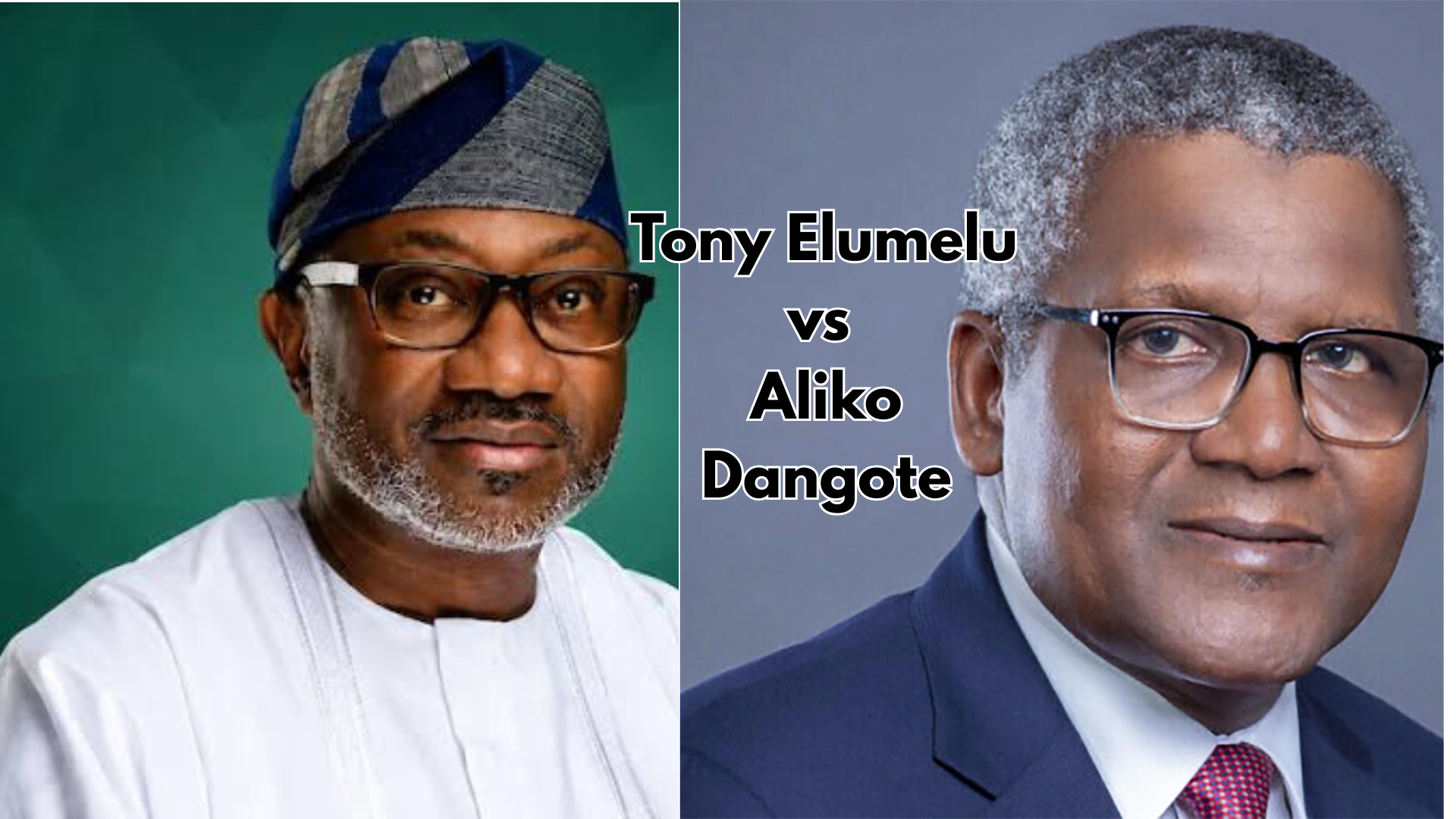
Tony Elumelu vs Aliko Dangote: Business, Wealth and How They Built Their Empires
Tony Elumelu and Aliko Dangote are two of the most prominent names in Nigerian business. Both have built major African business interests, invested heavily in Nigeria and become influential figures beyond the corporate world. However, their paths to wealth and the structures of their business empires are quite different.
Aliko Dangote built his fortune primarily through large-scale industrial businesses, particularly cement, manufacturing, and, more recently, oil refining. Tony Elumelu, on the other hand, has built a diversified investment portfolio spanning financial services, energy, power, hospitality, healthcare and technology through Heirs Holdings and related businesses.
The difference becomes particularly striking when their wealth is considered. Aliko Dangote remains Africa’s richest person, with Forbes estimating his real-time net worth at $31.3 billion as of August 27, 2026. Forbes’ 2026 annual billionaires list had previously valued his fortune at $28.5 billion based on March 1 figures. Tony Elumelu is also a highly successful businessman with significant interests in banking, energy, power, hospitality, technology, healthcare, and other sectors, but there is no equally reliable current Forbes real-time valuation of his personal fortune.
Absolutely. I would rewrite it in the Bioplaza style you have been developing, with fuller paragraphs, smoother transitions, and more substantial sentences rather than breaking the article into many short blocks. I would also remove the overly mechanical “winner” presentation and make the comparison read more like a well-researched business feature.
Tony Elumelu vs Aliko Dangote at a Glance
| Category | Aliko Dangote | Tony Elumelu |
|---|---|---|
| Date of birth | April 10, 1957 | March 22, 1963 |
| Main business identity | Industrialist and entrepreneur | Investor, banker and entrepreneur |
| Principal business vehicle | Dangote Group | Heirs Holdings |
| Major sectors | Cement, fertilizer, sugar, refining and other manufacturing | Banking, energy, power, insurance, hospitality, technology, healthcare and real estate |
| Banking background | Limited | Central to his rise in business |
| Major financial institution | Dangote Cement and other listed companies | United Bank for Africa |
| Major energy interest | Dangote Refinery and fertilizer | Heirs Energies and Transcorp’s energy businesses |
| Major philanthropic organisation | Aliko Dangote Foundation | Tony Elumelu Foundation |
| 2026 Forbes wealth | $28.5 billion on the annual list; $31.3 billion real-time on August 27, 2026 | No comparable current Forbes real-time valuation |
| Core business model | Industrial production and vertical integration | Long-term investment and business transformation |
| Geographic reach | Multiple African countries | Investments and operations across 24 countries |
Who Is Richer, Tony Elumelu or Aliko Dangote?
When the question is simply who has accumulated the greater personal fortune, Aliko Dangote is considerably wealthier than Tony Elumelu based on publicly verifiable information. Forbes‘ 2026 Africa billionaires list placed Dangote at the top of the continent with an estimated $28.5 billion, while Forbes’ current real-time profile puts his fortune at approximately $31.3 billion as of August 27, 2026. His fortune is closely connected to his ownership of Dangote Cement and his wider industrial interests.
The situation is different with Tony Elumelu because there is no current, independently verified Forbes figure that can be directly compared with Dangote’s real-time valuation. Elumelu’s wealth is spread across private and publicly traded investments, including his family-owned Heirs Holdings and interests associated with UBA and Transcorp, making an exact personal net-worth calculation considerably more difficult. Heirs Holdings itself describes the company as a private, family-owned investment company founded and chaired by Elumelu.
How Aliko Dangote Built His Wealth
Aliko Dangote’s business story began with trading rather than manufacturing. According to Dangote’s corporate history, the business that eventually became Dangote Industries began in 1981 as a trading enterprise dealing in commodities including cement, rice, sugar, flour and salt. Over time, the group moved away from dependence on imported products and began building manufacturing capacity in Nigeria and other African markets.
That transition from trading to manufacturing became one of the defining decisions of Dangote’s career. Instead of remaining primarily a distributor of imported goods, the group increasingly sought to control production itself, eventually building major businesses in cement, sugar, fertilizer, and other essential products. Dangote Cement became the most important component of this industrial strategy, growing into Africa’s largest cement producer and one of the principal sources of Dangote’s wealth. Forbes says Dangote owns 85 percent of publicly traded Dangote Cement through a holding company.
The strategy eventually extended into petroleum refining. The Dangote Refinery, which began construction in 2016 and commenced refining operations in early 2024, represents perhaps the most ambitious project in Dangote’s career. Forbes describes the refinery as a major component of his current business empire, while Dangote Industries identifies cement, refinery, fertilizer, sugar and salt among its principal industries. (Forbes)
The significance of this strategy is that Dangote has not simply accumulated companies; he has attempted to build large-scale production capacity around essential goods that African economies consume in enormous quantities. That approach has required enormous amounts of capital, infrastructure, and patience, but it has also created businesses capable of generating wealth on a continental scale.
How Tony Elumelu Built His Wealth
Tony Elumelu’s route was fundamentally different because banking and investment were at the centre of his early career. In 1997, he led a group that acquired the struggling Crystal Bank, which was subsequently transformed into Standard Trust Bank. According to Heirs Holdings, the turnaround demonstrated the importance of disciplined management, strategic investment and effective execution in transforming a struggling institution.
The next major turning point came in 2005, when Standard Trust Bank merged with United Bank for Africa. The transaction was described by Heirs Holdings as the largest banking merger in Africa at the time, and the resulting institution eventually developed from a largely domestic bank into a pan-African financial services group.
Elumelu’s banking career gave him something that would later become central to his wider business strategy: experience in identifying businesses with potential, providing capital, improving management and building institutions that could operate at a much larger scale. When he left his executive role at UBA in 2010, he established Heirs Holdings, a family-owned investment company designed to pursue long-term investments in strategic sectors of the African economy.
Today, Heirs Holdings says its investment portfolio covers power, energy, banking, insurance and financial services, technology, real estate, hospitality, and healthcare, with investments and operations spanning 24 countries. This makes Elumelu’s business model much more closely associated with investment diversification and strategic ownership than with the direct industrial manufacturing model associated with Dangote.
The Biggest Difference Between Their Business Models
The simplest way to understand the difference between the two businessmen is to look at what they have historically done with capital.
Aliko Dangote has primarily used capital to build and expand large industrial businesses, while Tony Elumelu has used capital to acquire, transform, operate and invest across a diversified portfolio of businesses.
Dangote’s empire is therefore strongly associated with physical production capacity. Cement plants, fertilizer facilities, sugar operations, and the refinery are examples of businesses where the creation of physical infrastructure is central to the strategy. Dangote Industries currently describes its principal industries as cement, refinery, fertilizer, sugar, and salt, with a presence in more than 12 African countries and more than 30,000 employees.
Elumelu’s approach is broader in terms of investment categories. Heirs Holdings has interests in financial services, energy, power, technology, healthcare, real estate, and hospitality, while Elumelu also chairs UBA and Transcorp. The result is an ecosystem of investments rather than an empire dominated by one particular industrial sector.
Tony Elumelu vs Aliko Dangote in Manufacturing
If the comparison is specifically about manufacturing and industrial production, Dangote has the stronger record by a considerable margin.
The Dangote Group evolved from a trading company into a manufacturing conglomerate, with cement becoming one of its most important businesses and the refinery representing a major expansion into petroleum processing. Dangote Cement alone has a production capacity of 48.6 million metric tonnes annually and operations across ten African countries, according to Forbes.
Elumelu has significant interests in operating businesses, particularly in energy and power, but manufacturing is not the defining feature of his business career. His strongest legacy lies in banking, investment, energy, corporate transformation, and entrepreneurship development.
On industrial manufacturing and physical infrastructure, Dangote clearly has the stronger record.
Tony Elumelu vs Aliko Dangote in Banking
Banking is one area where the comparison strongly favours Tony Elumelu.
The transformation of Standard Trust Bank and its eventual merger with UBA were crucial stages in his career. After the merger, Elumelu became chief executive of the enlarged group and pursued a pan-African strategy that helped transform UBA from a primarily Nigerian institution into an international African financial services group.
Elumelu continues to serve as chairman of UBA, which Heirs Holdings says operates across 20 African countries as well as the United Kingdom, France, the United Arab Emirates and the United States.
Dangote, on the other hand, did not build his fortune through banking. His wealth creation has overwhelmingly been connected to industrial and manufacturing businesses.
In banking and financial-sector leadership, Elumelu has the stronger story.
Tony Elumelu vs Aliko Dangote in Energy
Energy is one of the areas where their paths have increasingly begun to overlap, although their approaches remain different.
Dangote’s most visible energy investment is the Dangote Refinery, which began refining operations in early 2024 after years of development. The project represents a major attempt to establish large-scale petroleum refining capacity in Nigeria and forms part of Dangote’s broader strategy of building integrated industrial businesses.
Elumelu’s energy interests are distributed across Heirs Holdings and Transcorp. Heirs Holdings identifies Heirs Energies among its portfolio companies and describes its wider investment portfolio as including both energy and power. Transcorp, meanwhile, has significant interests in electricity generation.
The difference is therefore largely one of concentration and scale. Dangote has placed an enormous amount of capital into a single transformational refining project, whereas Elumelu has pursued a broader energy and power strategy through several investments.
In terms of the scale of a single energy project, Dangote has the advantage, while Elumelu has built a more diversified energy and power portfolio.
Tony Elumelu vs Aliko Dangote in Investment Diversification
This is one of the categories in which Tony Elumelu’s model stands out.
Heirs Holdings was specifically created as an investment company, and its portfolio covers sectors ranging from banking and insurance to energy, power, technology, healthcare, hospitality and real estate. The company says its investments operate across 24 countries and that its strategy is based on long-term capital allocation and operational expertise.
Dangote’s empire is also diversified, but the underlying strategy is different. His companies tend to be concentrated around industries connected to essential products and industrial production. The diversification therefore supports his manufacturing strategy rather than functioning primarily as a broad investment portfolio.
Elumelu therefore has the stronger investment-diversification model, while Dangote has the stronger industrial-diversification model.
Their Major Business Setbacks and Risks
Neither man’s success came without substantial risks, and their respective challenges reveal another major difference between their approaches to business.
For Dangote, perhaps the clearest example is the enormous financial and operational risk involved in constructing the Dangote Refinery. The project required years of development and an enormous investment before it could begin commercial operations. Forbes has described the refinery project as one of the biggest risks of Dangote’s career, particularly because of the extraordinary engineering, infrastructure and financial requirements involved in constructing such a facility.
Dangote’s broader business strategy has also required him to make long-term investments in manufacturing infrastructure before the full benefits of those investments could be realised. Moving from importing commodities to building factories fundamentally changed the risk profile of the business because manufacturing requires enormous upfront capital, technical expertise, infrastructure and sustained demand.
Elumelu’s risks have been different. His early decision to acquire and transform a struggling bank required him to take on an institution that was already facing serious difficulties. The eventual success of Standard Trust Bank and its merger with UBA demonstrated that turnaround investing could create substantial value when combined with strong management and strategic execution.
His subsequent investment strategy has involved taking long-term positions in sectors that are important to Africa’s economic development, including energy and power, where capital requirements, regulation and operational challenges can be substantial. His model therefore involves a different kind of risk: the risk of deploying capital into businesses that may take years to reach their full potential.
Their Major Triumphs
Dangote’s greatest triumph has arguably been the transformation of a relatively modest trading enterprise into a multinational industrial group. What began as a commodity-trading business eventually developed into a conglomerate with major interests in cement, fertilizer, sugar, refining and other essential sectors. Dangote Group now describes itself as one of Africa’s largest and most diversified business groups.
The scale of Dangote Cement illustrates this transformation particularly well. Forbes identifies it as the continent’s largest cement producer, while Dangote Cement reports a long-term strategy focused on helping African countries become more self-sufficient in cement production.
For Elumelu, the transformation of Standard Trust Bank and the subsequent merger with UBA stand among his most important business achievements. He later created Heirs Holdings and built a diversified investment platform spanning multiple strategic sectors. His influence also extends beyond business ownership through the Tony Elumelu Foundation, which focuses on supporting African entrepreneurs.
Their Approach to Philanthropy
The philanthropic legacies of both businessmen are also significant, although they have different areas of emphasis.
The Aliko Dangote Foundation has focused on areas including healthcare, education, nutrition and social welfare. Dangote’s philanthropic activities have therefore often been closely connected to large-scale social interventions and humanitarian programmes.
Tony Elumelu has placed entrepreneurship at the centre of his philanthropic work through the Tony Elumelu Foundation. Heirs Holdings says the foundation’s flagship entrepreneurship programme forms part of a $100 million commitment to fund, train and mentor African entrepreneurs, with the stated goal of helping build a stronger private sector across the continent.
This difference reflects their broader business philosophies. Dangote’s philanthropy is strongly associated with social welfare and large-scale intervention, while Elumelu’s philanthropy is closely connected to his belief in entrepreneurship as a mechanism for creating jobs, businesses and economic opportunity.
The Business Philosophy of Aliko Dangote
Dangote’s career demonstrates the potential of vertical integration and local production.
His early business involved importing commodities, but the group eventually moved toward manufacturing those products itself. The transformation of Dangote Cement is perhaps the clearest example of this strategy, with the company building production facilities close to major African markets rather than relying entirely on imports.
The same philosophy can be seen in the refinery and fertilizer businesses. Rather than simply participating in commodity trading, Dangote has increasingly attempted to control significant parts of the production chain.
This approach has made his businesses capital-intensive, but it has also created enormous industrial assets and positioned the group in sectors where demand is fundamental to economic development.
The Business Philosophy of Tony Elumelu
Tony Elumelu’s philosophy is commonly described through the concept of Africapitalism, which Heirs Holdings defines as the belief that the private sector can play a leading role in creating both economic and social wealth in Africa.
This philosophy is reflected in the way Heirs Holdings invests. Rather than focusing exclusively on short-term financial returns, the company says it seeks long-term investments in strategic sectors while using capital, sector expertise and operational experience to strengthen the businesses within its portfolio.
Elumelu’s model therefore combines commercial ambition with an explicit development objective. His argument is that profitable African businesses can simultaneously create employment, develop infrastructure, strengthen institutions and contribute to economic growth.
Who Has Built the Bigger Business Empire?
When measured by industrial scale and personal wealth, Aliko Dangote has built the larger business empire.
Dangote Industries reports operations across more than 12 African countries and more than 30,000 employees, with major businesses in cement, refining, fertilizer, sugar, and salt. Forbes’ 2026 figures also place Dangote among the world’s wealthiest individuals, with a real-time fortune exceeding $31 billion as of August 27, 2026.
Elumelu’s empire is substantial in its own right, particularly when his interests in UBA, Transcorp, and Heirs Holdings are considered together. Heirs Holdings says its portfolio spans 24 countries and includes financial services, energy, power, technology, healthcare, hospitality, and real estate.
The difference is that Dangote’s empire is built around large industrial assets, whereas Elumelu’s is built around ownership stakes, investments, and operating companies across multiple sectors.
THE MAJOR LESSON
There is no single formula for building a major African business empire. Aliko Dangote demonstrates the power of manufacturing, vertical integration and long-term investment in physical infrastructure, while Tony Elumelu demonstrates how banking expertise, strategic capital allocation and diversified investment can transform businesses and create lasting economic influence.
Tony Elumelu vs Aliko Dangote: Who Is the Better Businessman?
The answer depends largely on what aspect of business success is being measured.
If the standard is industrial scale, manufacturing capacity, and personal wealth, Dangote has the stronger record. His businesses have created some of Africa’s largest industrial assets, and his fortune is several times larger than any reliably documented current estimate for Elumelu.
If the standard is banking, corporate turnaround, investment diversification, and entrepreneurship development, Elumelu’s career is particularly impressive. His transformation of Standard Trust Bank, leadership of UBA, and creation of Heirs Holdings demonstrate a different form of business expertise that has allowed him to build influence across several industries.
It is therefore more useful to describe them as two different models of African entrepreneurship rather than simply declaring one the better businessman.
Final Verdict: Tony Elumelu vs Aliko Dangote
Aliko Dangote wins in overall wealth and industrial scale, while Tony Elumelu stands out for banking, strategic investment, and entrepreneurship development.
Dangote’s greatest strength has been his ability to take businesses that depend on imports and transform them into large-scale manufacturing operations capable of serving African markets. His cement business, fertilizer operation, and refinery demonstrate a consistent preference for controlling production and building physical infrastructure at an enormous scale.
Elumelu’s strength lies in a different form of value creation. From turning around Standard Trust Bank to helping transform UBA into a pan-African financial institution and subsequently building Heirs Holdings, his career has been defined by identifying opportunities, allocating capital, transforming businesses, and building diversified investments.
The comparison ultimately comes down to two different philosophies of wealth creation. Dangote’s story is largely the story of building the factories, plants, and infrastructure that produce what Africa consumes, while Elumelu’s story is the story of investing in and transforming the institutions and businesses that help Africa’s economy function and grow.
For aspiring entrepreneurs, the most valuable lesson may therefore not be deciding who is better, but understanding what each man’s career demonstrates: Dangote shows the power of scale and production, while Elumelu shows the power of capital, transformation, and diversification.
Sources
- Forbes — Aliko Dangote profile and real-time net worth. (Forbes)
- Forbes — Africa’s Billionaires 2026. (Forbes)
- Dangote Industries Limited — Company history, businesses and corporate profile. (dangote.com)
- Dangote Cement — History and development of the Dangote business. (cement.dangote.com)
- Dangote Cement — Aliko Dangote profile. (cement.dangote.com)
- Heirs Holdings — Company history, portfolio, and Tony Elumelu profile. (Heirs Holdings)
- Heirs Holdings — Frequently Asked Questions and investment portfolio. (Heirs Holdings)
- Heirs Holdings — History of Tony Elumelu’s banking career and Heirs Holdings. (Heirs Holdings)