
Top 30 Richest Countries in the World in 2026: GDP, Wealth & Rankings
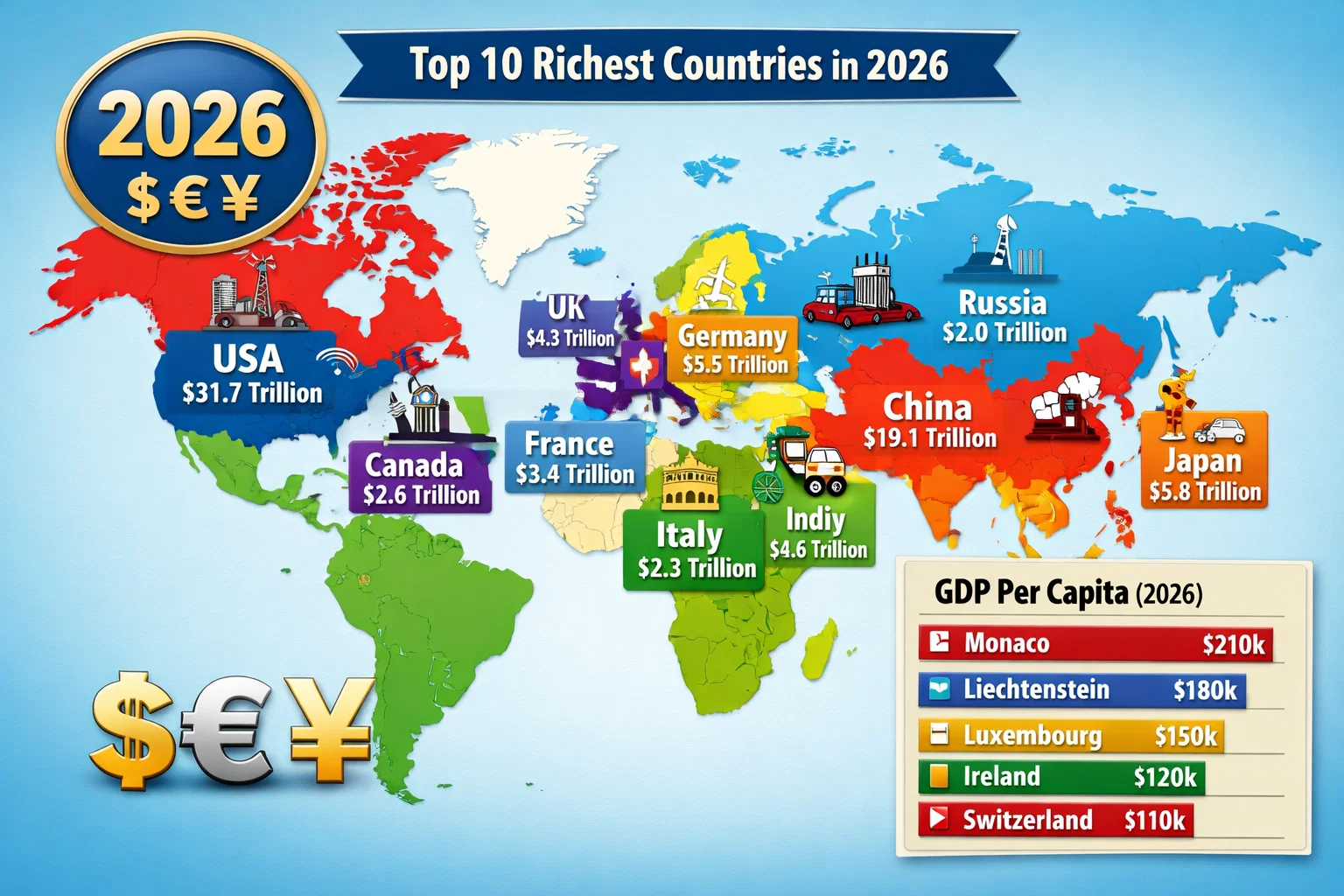
What makes a country truly “rich”? Is it the sheer size of its economy, measured in trillions of dollars? Is it the average income of its citizens, reflecting their daily quality of life? Or is it the untapped value of oil, gas, minerals, and forests lying beneath its soil? The answer, as economists have long debated, depends entirely on how you define and measure wealth. In 2026, the global economic landscape is more dynamic and multipolar than ever before. Traditional superpowers like the United States and China continue to dominate in total output, while smaller, agile nations like Luxembourg, Singapore, and Monaco lead the world in per capita prosperity. According to the International Monetary Fund’s (IMF) January 2026 World Economic Outlook update, global GDP is projected to grow by 3.3% this year. In this comprehensive guide, we rank the richest countries in the world in 2026 using three key metrics: Nominal GDP, GDP per Capita, and GDP based on Purchasing Power Parity (PPP).
READ ALSO Top 10 Most Controversial Celebrities in the World (2026 Update)
Each measurement tells a different story. Nominal GDP reveals which countries produce the most economic value in current dollar terms — a measure where the United States and China dominate, together accounting for over 42% of the global economy. GDP per capita, on the other hand, adjusts for population size, offering a clearer picture of average living standards. By this measure, tiny nations like Monaco ($256,000 per person), Liechtenstein, and Luxembourg far outrank economic giants like the US and China. Meanwhile, PPP adjustments account for cost-of-living differences, showing that a dollar buys much more in some countries than others — which is why China’s economy surpasses America’s when measured this way. Each metric has its strengths and blind spots, and understanding them is essential to making sense of global wealth rankings.
Beyond these traditional economic indicators, natural resource wealth also plays a crucial role in determining a nation’s long-term prosperity. Countries like Russia ($75 trillion in estimated resources), Saudi Arabia, and the Democratic Republic of Congo sit atop staggering reserves of oil, gas, cobalt, and rare earth minerals — resources that are increasingly vital to the global green energy transition and tech manufacturing. In this article, we will also explore which nations hold the most valuable natural assets, highlight notable movers who have climbed or fallen in the 2026 rankings, and provide a complete picture of the world’s wealthiest economies. Whether you’re an investor, a student of economics, or simply curious about global finance, this guide offers the definitive, data-driven answer to the question: who are the richest countries in the world in 2026?
How to Measure a Country’s Wealth
Before we reveal the rankings, it’s important to understand the different ways economists measure national wealth:
| Metric | What It Measures | Best For |
|---|---|---|
| Nominal GDP | Total value of goods and services produced at current exchange rates | Comparing the sheer size of economies |
| GDP per Capita | Nominal GDP divided by population | Understanding average living standards |
| GDP (PPP) | GDP adjusted for local purchasing power and price levels | Comparing real buying power across countries |
| Natural Resources | Estimated value of untapped oil, gas, minerals, and timber | Measuring potential future wealth |
Each metric tells a different story. A country like China has an enormous total economy but a lower GDP per capita due to its massive population. Meanwhile, a small nation like Luxembourg has a tiny total GDP but an extraordinarily high per capita income.
Richest Countries by Nominal GDP (Total Economic Output)
Nominal GDP is the most commonly cited measure of a country’s economic size. It reflects the current market value of all finished goods and services produced within a country’s borders. According to IMF data for 2026, the global economy is projected to reach approximately $123.6 trillion.
Here are the top 30 richest countries by nominal GDP in 2026:
| Rank | Country | Nominal GDP (USD) | Global Share |
|---|---|---|---|
| 1 | 🇺🇸 United States | $31.82 trillion | 25.7% |
| 2 | 🇨🇳 China | $20.65 trillion | 16.7% |
| 3 | 🇩🇪 Germany | $5.33 trillion | 4.3% |
| 4 | 🇮🇳 India | $4.51 trillion | 3.6% |
| 5 | 🇯🇵 Japan | $4.46 trillion | 3.6% |
| 6 | 🇬🇧 United Kingdom | $4.23 trillion | 3.4% |
| 7 | 🇫🇷 France | $3.56 trillion | 2.9% |
| 8 | 🇮🇹 Italy | $2.70 trillion | 2.2% |
| 9 | 🇷🇺 Russia | $2.51 trillion | 2.0% |
| 10 | 🇨🇦 Canada | $2.42 trillion | 2.0% |
| 11 | 🇧🇷 Brazil | $2.29 trillion | 1.9% |
| 12 | 🇪🇸 Spain | $2.04 trillion | 1.6% |
| 13 | 🇲🇽 Mexico | $2.03 trillion | 1.6% |
| 14 | 🇦🇺 Australia | $1.95 trillion | 1.6% |
| 15 | 🇰🇷 South Korea | $1.94 trillion | 1.6% |
| 16 | 🇹🇷 Turkey | $1.58 trillion | 1.3% |
| 17 | 🇮🇩 Indonesia | $1.55 trillion | 1.3% |
| 18 | 🇳🇱 Netherlands | $1.41 trillion | 1.1% |
| 19 | 🇸🇦 Saudi Arabia | $1.32 trillion | 1.1% |
| 20 | 🇵🇱 Poland | $1.11 trillion | 0.9% |
| 21 | 🇨🇭 Switzerland | $1.07 trillion | 0.9% |
| 22 | 🇹🇼 Taiwan | $971 billion | 0.8% |
| 23 | 🇧🇪 Belgium | $761 billion | 0.6% |
| 24 | 🇮🇪 Ireland | $750 billion | 0.6% |
| 25 | 🇸🇪 Sweden | $712 billion | 0.6% |
| 26 | 🇦🇷 Argentina | $668 billion | 0.5% |
| 27 | 🇮🇱 Israel | $666 billion | 0.5% |
| 28 | 🇸🇬 Singapore | $606 billion | 0.5% |
| 29 | 🇦🇹 Austria | $604 billion | 0.5% |
| 30 | 🇦🇪 United Arab Emirates | $601 billion | 0.5% |
Key Takeaways:
-
The United States remains the world’s largest economy, with a GDP of nearly $32 trillion.
-
China holds second place, but its economy is projected to grow at 4.2% in 2026, faster than the US’s 2.1%.
-
India has overtaken Japan to claim the fourth spot, driven by 6.2% GDP growth — the fastest among the top 10.
-
Russia remains in the top 10 despite ongoing sanctions, with a projected GDP of $2.51 trillion.
-
Notable new entrants in the top 50 include Kazakhstan (ranked 49th with $320 billion), reflecting Central Asia’s growing economic significance.
Richest Countries by GDP per Capita (Average Wealth per Person)
While nominal GDP tells you which countries have the biggest economies, GDP per capita gives a clearer picture of average living standards. Small nations with highly specialized economies often top this list.
According to CEOWORLD magazine’s analysis of IMF 2026 projections, here are the richest countries by GDP per capita:
| Rank | Country | GDP per Capita (USD) | Region |
|---|---|---|---|
| 1 | 🇲🇨 Monaco | $256,667 | Western Europe |
| 2 | 🇱🇮 Liechtenstein | $201,162 | Western Europe |
| 3 | 🇱🇺 Luxembourg | $154,115 | Western Europe |
| 4 | 🇮🇪 Ireland | $135,247 | Northern Europe |
| 5 | 🇨🇭 Switzerland | $118,173 | Western Europe |
| 6 | 🇮🇸 Iceland | $108,591 | Northern Europe |
| 7 | 🇸🇬 Singapore | $99,042 | Southeast Asia |
| 8 | 🇳🇴 Norway | $96,580 | Northern Europe |
| 9 | 🇺🇸 United States | $92,883 | North America |
| 10 | 🇩🇰 Denmark | $82,706 | Northern Europe |
| 11 | 🇳🇱 Netherlands | $77,881 | Western Europe |
| 12 | 🇲🇴 Macao (PRC) | $77,443 | Eastern Asia |
| 13 | 🇶🇦 Qatar | $76,534 | Western Asia |
| 14 | 🇸🇲 San Marino | $69,493 | Southern Europe |
| 15 | 🇦🇺 Australia | $69,358 | Oceania |
| 16 | 🇸🇪 Sweden | $66,124 | Northern Europe |
| 17 | 🇦🇹 Austria | $65,640 | Western Europe |
| 18 | 🇮🇱 Israel | $64,275 | Western Asia |
| 19 | 🇧🇪 Belgium | $63,896 | Western Europe |
| 20 | 🇩🇪 Germany | $63,600 | Western Europe |
What Makes These Countries So Rich?
-
Monaco tops the list with $256,667 per capita, thanks to its zero-income-tax policy, luxury tourism, and status as a haven for the ultra-wealthy.
-
Ireland ranks fourth due to its low corporate tax rate, which has attracted the European headquarters of Apple, Google, and Meta, inflating its GDP figures.
-
Singapore ($99,042) thrives as a global trade, finance, and logistics hub with world-class governance.
-
Norway channels its oil wealth into the world’s largest sovereign wealth fund (over $1.4 trillion), ensuring intergenerational prosperity.
-
The United States remains the richest large-population country, with a per capita income of nearly $93,000 — unmatched among nations with over 10 million citizens.
Richest Countries by GDP (PPP) – Adjusting for Cost of Living
Purchasing Power Parity (PPP) adjusts for price level differences between countries, giving a more accurate picture of what people can actually buy with their income. In 2026, China leads the world in PPP terms:
| Rank | Country | GDP (PPP) in Trillions (Int$) | GDP per Capita (PPP) |
|---|---|---|---|
| 1 | 🇨🇳 China | $43.49 trillion | $31,023 |
| 2 | 🇺🇸 United States | $31.82 trillion | $92,883 |
| 3 | 🇮🇳 India | $19.14 trillion | $12,964 |
| 4 | 🇷🇺 Russia | $7.34 trillion | $50,571 |
| 5 | 🇯🇵 Japan | $6.92 trillion | $56,444 |
| 6 | 🇩🇪 Germany | $6.32 trillion | $75,480 |
| 7 | 🇮🇩 Indonesia | $5.36 trillion | $18,657 |
| 8 | 🇧🇷 Brazil | $5.16 trillion | $24,108 |
| 9 | 🇫🇷 France | $4.66 trillion | $67,671 |
| 10 | 🇬🇧 United Kingdom | $4.59 trillion | $65,215 |
Key Insight: When measured in PPP terms, China’s economy is nearly $12 trillion larger than the US’s, reflecting the lower cost of goods and services within China. India also jumps to third place globally, ahead of Japan and Germany.
For GDP per capita in PPP terms, the rankings look different. According to Worldometer’s IMF data, these are the top performers:
| Rank | Country | GDP per Capita (PPP) |
|---|---|---|
| 1 | 🇱🇮 Liechtenstein | $206,120 |
| 2 | 🇸🇬 Singapore | $161,546 |
| 3 | 🇱🇺 Luxembourg | $155,275 |
| 4 | 🇮🇪 Ireland | $150,865 |
| 5 | 🇲🇴 Macao | $136,809 |
| 6 | 🇶🇦 Qatar | $131,402 |
| 7 | 🇧🇲 Bermuda | $119,719 |
| 8 | 🇬🇾 Guyana | $117,535 |
| 9 | 🇳🇴 Norway | $109,528 |
| 10 | 🇨🇭 Switzerland | $99,973 |
Guyana is a remarkable story here: the South American nation has seen explosive growth due to recent offshore oil discoveries, catapulting its PPP per capita to $117,535.
World’s Richest Nations by Natural Resources (2026)
Wealth isn’t just about what a country produces — it’s also about what lies beneath its soil. According to Gulf News’ 2026 analysis based on World Bank and IMF data, here are the nations with the most valuable natural resource reserves:
| Rank | Country | Estimated Resource Value | Key Resources |
|---|---|---|---|
| 1 | 🇷🇺 Russia | $75 trillion | Natural gas, oil, coal, timber, rare earth metals |
| 2 | 🇺🇸 United States | $45 trillion | Coal, timber, natural gas, gold |
| 3 | 🇸🇦 Saudi Arabia | $34.4 trillion | Oil, natural gas, phosphates |
| 4 | 🇨🇦 Canada | $33.2 trillion | Oil sands, uranium, timber |
| 5 | 🇮🇷 Iran | $27.3 trillion | Oil, natural gas |
| 6 | 🇨🇩 DRC | $24 trillion | Cobalt (70% of global reserves), copper, diamonds |
| 7 | 🇨🇳 China | $23 trillion | Rare earth metals, coal, timber |
| 8 | 🇧🇷 Brazil | $21.8 trillion | Timber, iron ore, gold |
| 9 | 🇦🇺 Australia | $19.9 trillion | Iron ore, coal, uranium |
| 10 | 🇮🇶 Iraq | $15.9 trillion | Oil |
Per Capita Natural Resource Wealth: When adjusted for population, Saudi Arabia leads at nearly $1 million per person, followed by Canada ($822,000) and Australia ($727,000).
The DRC’s cobalt reserves are particularly significant in 2026, as cobalt is essential for electric vehicle batteries and the global green energy transition.
READ ALSO Top 20 Youngest Billionaires in the World (2026)
Notable Changes in the 2026 Global Rankings
Several countries have moved up or down the rankings compared to previous years:
-
India officially overtook Japan in 2025 and now holds the #4 spot in nominal GDP, a position it is expected to maintain.
-
Australia ($1.95 trillion) displaced South Korea ($1.94 trillion) for 14th place, thanks to strong commodity exports.
-
Bangladesh (33rd place with $519 billion) surpassed Vietnam, driven by 4.9% economic growth and a thriving textile industry.
-
Egypt rose to 43rd place, while Nigeria entered the top 50 at 48th position.
-
Kazakhstan entered the top 50 for the first time, reflecting Central Asia’s growing economic weight.
Final Thoughts
The title of “richest country” depends entirely on how you measure wealth. The United States leads in nominal GDP and remains the most productive large economy. China dominates in PPP terms and is closing the gap in nominal terms. Luxembourg, Singapore, and Monaco offer their citizens the highest standards of living. And Russia sits atop the world’s most valuable natural resource reserves.
For investors, business leaders, and policymakers, the key takeaway is this: the richest countries in the world in 2026 are those that combine strategic foresight, innovation, and disciplined governance. Small nations like Ireland and Singapore have proven that you don’t need vast land or resources to create immense wealth — you just need the right policies.
As the global economy continues to evolve, driven by AI, renewable energy, and shifting trade patterns, expect these rankings to keep changing. One thing is certain: the race for economic supremacy is far from over.